Designing a Hypothetical NeuroModulation Constellation
A rigorous engineering analysis of what a satellite constellation designed for neural-range electromagnetic delivery would require — from orbital mechanics and antenna design to power budgets and the fundamental physics that makes it impossible.

Constellation Sizing — How Many Satellites?
Any satellite-based neuromodulation system would require continuous, high-power, focused coverage of target areas on the ground. Unlike communication satellites that can share bandwidth across millions of users, a neuromodulation satellite would need to deliver a dedicated, focused beam to each target — with power densities many orders of magnitude beyond what communication links require.[48]
At 550 km altitude, a single LEO satellite’s coverage footprint is approximately 1,000 km in diameter (for a minimum elevation angle of 25°). However, each satellite is visible from any given ground point for only 5–8 minutes per pass. To provide continuous coverage at a single point, you need at least 6–8 satellites in view at all times.[48]
| System | Satellites | Altitude | Purpose |
|---|---|---|---|
| GPS | 31 | 20,180 km | Navigation (MEO) |
| Iridium | 66 | 780 km | Voice/Data (LEO) |
| Starlink Gen2 | ~12,000 | 340–614 km | Broadband (LEO) |
| OneWeb | 648 | 1,200 km | Broadband (LEO) |
| Hypothetical NeuroMod | 500,000+ | 550 km | Focused EM delivery |
Continuous Coverage Requirement
Cakaj et al. (2021) analyzed LEO constellation sizing for continuous coverage. At 550 km altitude, providing global continuous coverage with a minimum elevation angle of 40° requires approximately 2,000–4,000 satellites in multiple orbital planes (depending on inter-satellite link architecture). But this is for communication — a simple data link. A neuromodulation system would require far denser coverage for the power and beam requirements.[48]
The Density Problem
A neuromodulation satellite would need to deliver focused energy to a target area of ~10 cm² (a brain region) from 550 km away. This requires an antenna aperture of hundreds of meters (physical optics limit) and power levels that scale with the 10¹⁷ gap. Even distributing the load across multiple satellites in a phased array doesn’t close this gap — you’d need millions of satellites acting as a coherent aperture, which is beyond any conceivable engineering.[48][49]
Constellation Sizing — Satellites Required by Application
Logarithmic comparison of satellite constellation sizes: from existing systems (GPS, Starlink) to theoretical requirements for focused EM delivery and direct neural modulation from orbit.
Power Budget & Link Analysis — The Numbers
A link budget is the fundamental engineering tool for analyzing any wireless communication or energy delivery system. It accounts for every gain and loss between transmitter and receiver: transmit power, antenna gain, free-space path loss, atmospheric attenuation, and receiver sensitivity.[49]
For a hypothetical neuromodulation satellite operating at 1 GHz from 550 km altitude, the numbers are devastating:
Transmit Power
A state-of-the-art communication satellite transmitter delivers about ~200 W (23 dBW) of RF power. Even military AESA radars on satellites are limited to ~1–10 kW by solar panel capacity and thermal constraints. Solar power in LEO: ~1,361 W/m² × ~30% efficiency × panel area.[49]
Antenna Gain (EIRP)
A large satellite dish antenna (1 m diameter at 1 GHz) provides about 20 dBi of gain, giving an EIRP (Effective Isotropic Radiated Power) of ~43 dBW. Starlink satellites achieve ~38–40 dBW EIRP. Even a 10 m deployable antenna (beyond current capability) would add only 20 dB more.[49]
Free-Space Path Loss
At 1 GHz and 550 km, FSPL = 20·log₁₀(4πd/λ) ≈ ~167 dB. Add 1–3 dB for atmospheric absorption, rain fade, and ionospheric effects. The signal arriving at ground level is ~43 − 167 = −124 dBW/m², or roughly 4 × 10⁻¹³ W/m². This is approximately what GPS receivers detect.[49][4]
Biological Threshold Gap
The weakest known electromagnetic biological effect (the Frey auditory effect) requires a power density of approximately ~40 mW/cm² = 400 W/m². The gap between satellite signal at ground and this threshold: 400 / (4 × 10⁻¹³) = 10¹⁵ — or roughly 150 dB. No physically realizable antenna, power system, or beam-forming technology closes a 150 dB gap.[49][10]
Satellite Link Budget — Power Flow Analysis
Waterfall diagram of satellite downlink power budget from 200W transmitter through free-space path loss to ground-level reception, compared against biological effect thresholds.
Payload Architecture — What Would a NeuroSat Carry?
Despite the fundamental physics barriers, let us conduct the thought experiment: what would a satellite designed for neural-range electromagnetic delivery look like? The payload requirements reveal why the concept is impossible even before considering the link budget.
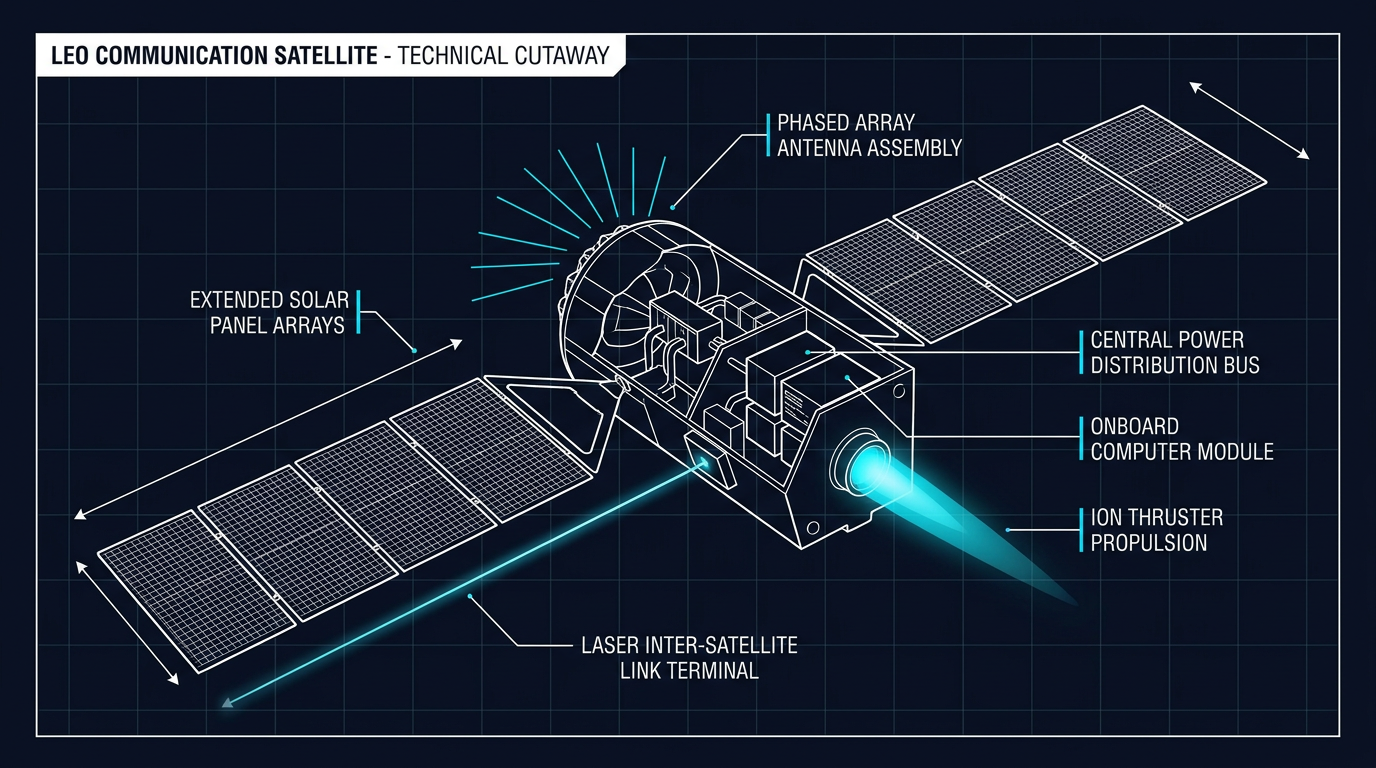
Active Phased-Array Antenna
To focus RF energy to a ~10 cm² target area on the ground from 550 km, the Rayleigh criterion requires an antenna diameter of D ≥ 1.22 × λ × R / d ≈ 1.22 × 0.3 m × 550,000 m / 0.1 m ≈ 2,013 km at 1 GHz. Even at 100 GHz (3 mm wavelength), the aperture would need to be ~20 km. This is physically impossible for any single satellite.[49]
Solid-State Power Amplifier (SSPA)
State-of-the-art GaN SSPAs for satellite applications deliver 100–500 W of RF power per module. To close the 150 dB link budget gap, you would need a transmitter power of ~10¹⁷ W — equivalent to ~10 million GW, approximately 1,000× the total power output of human civilization. Solar panels clearly cannot provide this.
Solar Arrays & Power System
A large communication satellite generates ~20 kW from solar panels spanning ~50 m² of GaAs triple-junction cells (30% efficiency, ~1,361 W/m² irradiance in LEO). Even the ISS, with ~2,500 m² of solar panels, produces only ~120 kW. Battery systems (Li-ion, ~250 Wh/kg) provide eclipse survival but cannot store the energy needed for MW-class transmitters.
Onboard Processor & Beam Steering
Real-time beam steering to track a moving target on Earth from a satellite moving at 7.66 km/s requires sub-millisecond pointing updates. Modern radiation-hardened processors (e.g., RAD750, LEON4) can handle this computation, but the antenna size requirement makes physical beam steering impossible.
Laser Inter-Satellite Link (ISL)
Starlink satellites use laser ISLs (1,550 nm wavelength) for satellite-to-satellite communication at ~100 Gbps. A neuromodulation constellation would need ISLs for coordination of phased-array beamforming across thousands of satellites — requiring synchronization accuracy of ~10 picoseconds, beyond current ISL capabilities.
Electric Propulsion (Ion Thruster)
Hall-effect or ion thrusters (e.g., Starlink uses krypton Hall thrusters) provide station-keeping and orbit maintenance. At 550 km, atmospheric drag requires periodic reboosting. Typical Δv budget: ~50–100 m/s per year, consuming ~10–30 kg of propellant. With 500,000+ satellites, propellant logistics alone would be staggering.
Onboard Technology Stack — The Board
A realistic satellite board for a LEO communication satellite includes the following subsystems. Even this simplified architecture reveals the engineering constraints that make neural-range power delivery impossible:
OBC (On-Board Computer)
RAD750 or LEON4 processor, 256 MB radiation-hardened RAM, triple-modular redundancy, ~400 MHz clock.
Command/data handling, attitude determination, payload scheduling.
ADCS (Attitude Determination)
Star trackers (0.001°), reaction wheels (4x, 0.5 Nms), magnetorquers, IMU.
Precise pointing control for antenna beamsteering.
EPS (Electrical Power)
GaAs triple-junction cells (30%), 20–40 V bus, MPPT controller, Li-ion batteries (250 Wh/kg).
Generate, regulate, and store electrical power. ~5–20 kW for comm sats.
RF Payload
GaN SSPA (100–500 W), LNA, mixer, ADC/DAC, digital beamformer FPGA.
Signal amplification, frequency conversion, beam shaping.
TT&C (Telemetry)
S-band uplink/downlink (2 GHz), ~1–10 kbps, encryption module.
Ground station communication, health monitoring, command reception.
Thermal Control
MLI blankets, heat pipes, radiator panels, heaters for eclipse periods.
Maintain components within operating temperature range (−20 to +50°C typical).
Engineering Reality: Even the most advanced satellite bus generates ~20 kW of power and carries transmitters of ~500 W. The power requirement for closing the neural stimulation link budget (~10¹⁷ W) exceeds what the entire Starlink constellation produces combined.
Why Current Satellite Designs Are Fundamentally Inadequate
The gap between what satellites can deliver and what neural stimulation requires is not an engineering challenge — it is a physics barrier. No combination of larger antennas, more satellites, higher orbits, or better amplifiers can bridge a 150+ dB shortfall.[49][48]
Antenna Aperture Impossible
Focusing to brain-region precision from LEO requires an antenna 2,000+ km across at 1 GHz — larger than most countries. Even distributed arrays cannot achieve coherent phasing at this scale.
Power Beyond Civilization
Closing the link budget requires transmitter power of ~10¹⁷ W. Total human power production is ~1.8 × 10¹³ W. The gap: 10,000× all of human civilization's power.
Orbital Debris Catastrophe
Launching 500,000+ satellites would create an orbital debris crisis. At current Starlink failure rates (~2%), that's 10,000+ dead satellites creating Kessler syndrome risk.
Economic Impossibility
At ~$500K per satellite (Starlink-class), a 500,000-satellite constellation would cost ~$250 billion just for hardware, before launch costs ($2,000/kg × 260 kg × 500K = $260B in launches).