Research Approach & Limitations
How this interdisciplinary review was conducted, what sources were selected, and what this project can and cannot claim.
Research Approach
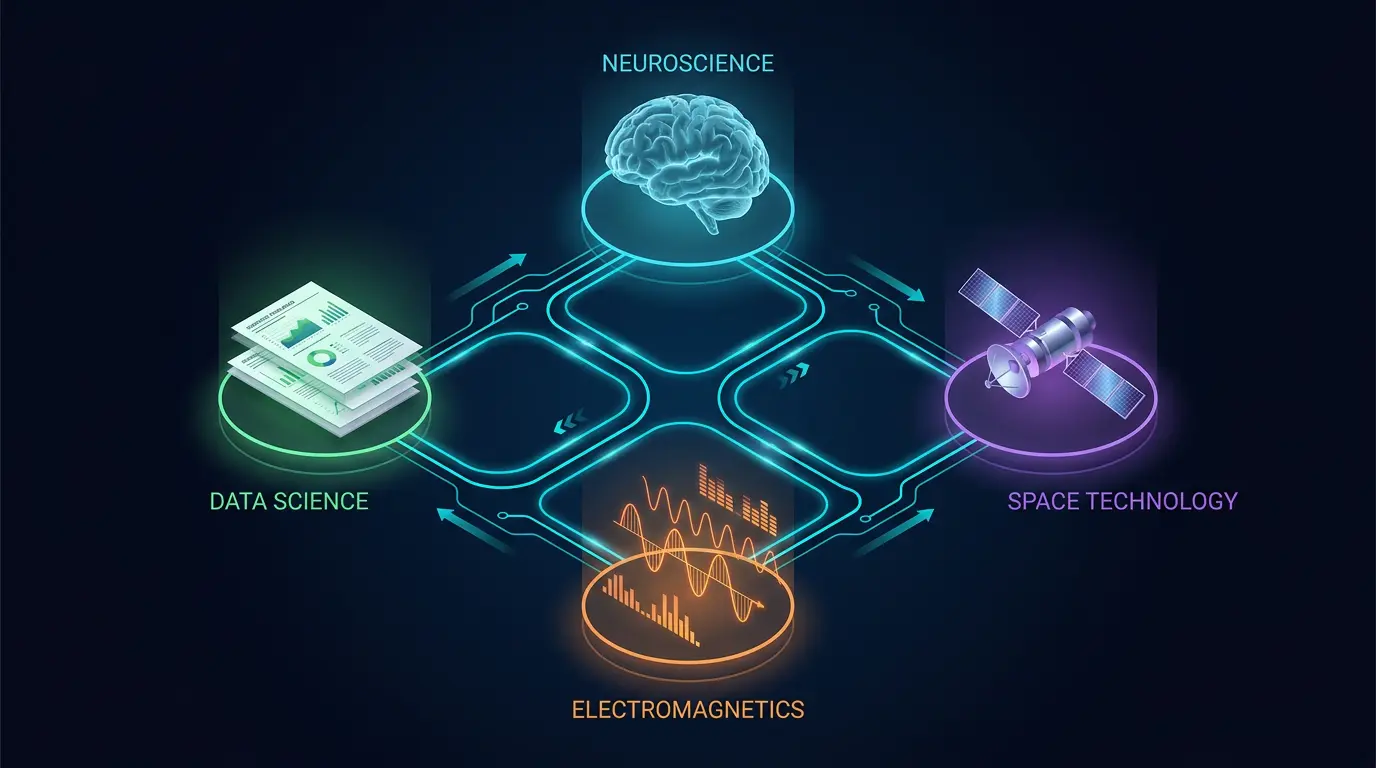
This project synthesizes published research across eight distinct scientific domains to evaluate a specific question: Is satellite-based neuromodulation physically feasible? The approach is interdisciplinary, drawing from:
Neuroscience
Neuromodulation techniques, required energy levels, spatial resolution requirements
Electromagnetic Biology
RF-tissue interaction mechanisms, SAR standards, biological effect thresholds
Satellite Engineering
Constellation specifications, link budgets, EIRP calculations, path loss physics
Brain-Computer Interfaces
Current BCI capabilities, electrode technology, signal processing state-of-art
Sensory & Cognitive
Visual, auditory, olfactory, gustatory, and cognitive effects of EM stimulation
Body Control
TMS motor evoked potentials, FES, epidural spinal cord stimulation, BCI motor prosthetics
Satellite Architecture
Constellation sizing, payload design, link budget analysis, onboard technology stack
Physics
Free-space path loss, inverse-square law, atmospheric attenuation, thermal noise floor
The analysis follows a convergence methodology: each domain is reviewed independently, then the intersection points are examined to identify where physical constraints create fundamental barriers versus engineering challenges.
Source Selection Criteria
Sources were selected based on the following priority hierarchy:
Peer-reviewed journal articles
Nature, Frontiers, PLOS, IEEE, Astronomy & Astrophysics — primary authority
Government and institutional reports
NCBI bookshelf, NRAO memos, FCC/ITU technical documents
Foundation and preprint publications
eLife reviewed preprints, Focused Ultrasound Foundation, arXiv
Science journalism and technical analyses
Used sparingly for context on recent developments not yet in peer-reviewed literature
All quantitative claims (power densities, SAR values, path loss calculations, field strengths) are derived from peer-reviewed or institutional sources. Journalistic sources are used only for timeline information and technology status updates.
Domain Coverage & Reference Distribution
The reference distribution reflects the interdisciplinary nature of the analysis. Neuromodulation receives the heaviest coverage as it forms the primary technology under evaluation, while satellite engineering and EM biology provide the constraint analysis.
Limitations & Caveats
Not a Systematic Review
This project does not follow PRISMA guidelines or systematic review methodology. It is a narrative review designed for educational and creative purposes, not clinical decision-making.
Rapidly Evolving Fields
Both BCI technology and satellite engineering are advancing rapidly. Specifications and capabilities cited here are accurate as of early 2026 but may be superseded.
Speculative Sections
The "Future Directions" section contains theoretical extrapolations not backed by peer-reviewed feasibility studies. These are clearly marked as speculative.
Physics-Focused Analysis
The feasibility analysis focuses primarily on electromagnetic physics constraints. Biological complexity (individual variation, neural network dynamics, consciousness) adds additional layers of impossibility not fully quantified here.
About This Project
NeuroSat Science is an interdisciplinary scientific exploration project examining the intersection of neuroscience, electromagnetic biology, satellite technology, and brain-computer interfaces.
The project was created as a research and creative endeavor to rigorously evaluate claims about satellite-based neural influence using publicly available scientific literature. The goal is to provide a fact-based, quantitative analysis accessible to researchers, students, and scientifically curious individuals.
All content is grounded in peer-reviewed research. The project does not promote conspiracy theories and explicitly demonstrates through quantitative physics analysis that current satellite technology is incapable of neuromodulation.