Direct Neural Communication — Mind to Machine
From the pioneering BrainGate Utah Array to Neuralink's flexible threads — the evolution of brain-computer interfaces from laboratory research to clinical reality.
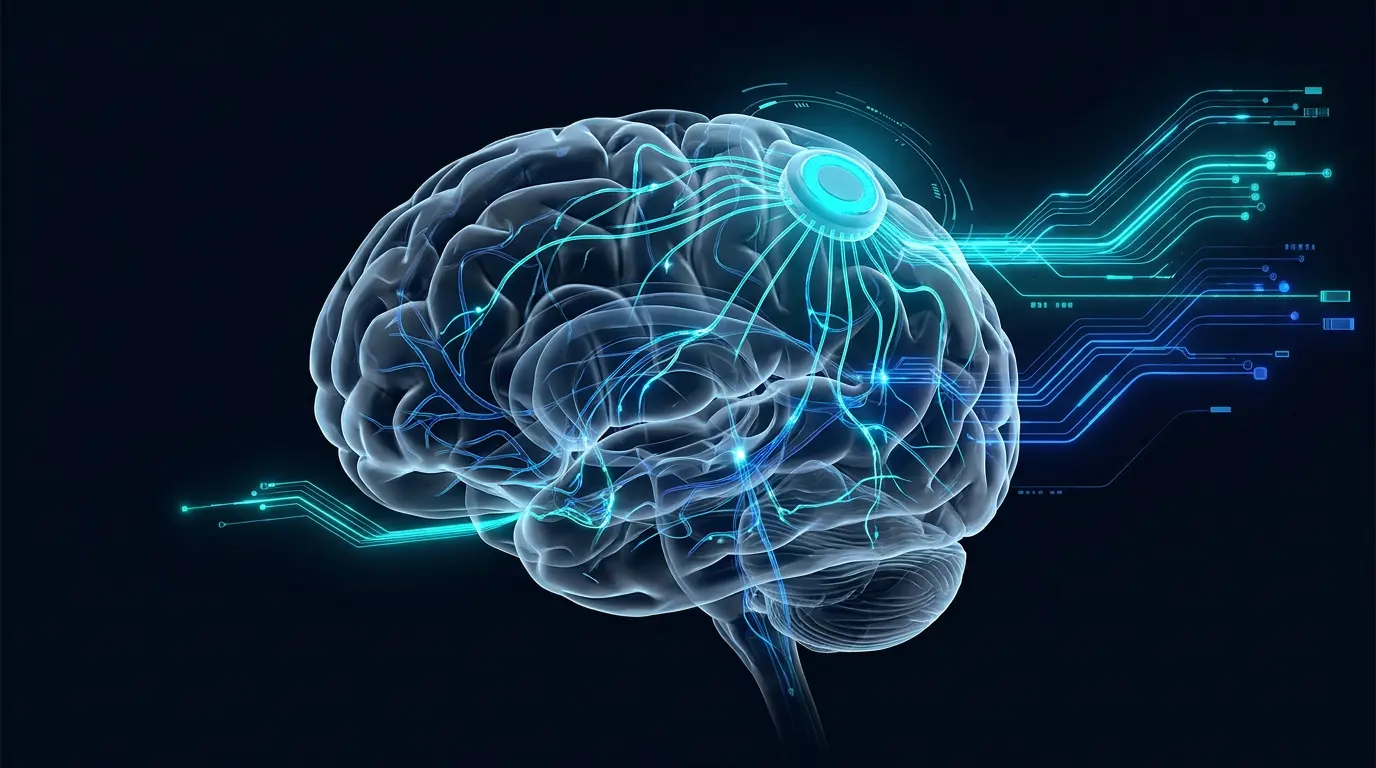
BrainGate: Pioneering Invasive BCIs
The BrainGate consortium, a collaboration involving Brown University, Massachusetts General Hospital, Stanford University, and Case Western Reserve University, marked the dawn of clinically effective invasive BCIs. Central to this system is the Utah Array (Blackrock Neurotech), a 4×4 mm silicon chip with 96 microelectrodes, each 1.0–1.5 mm long, that penetrate the motor cortex to record individual neuron activity (single-unit action potentials and multi-unit activity).[3][15][59]
Key Milestones
In 2004, the first participant, Matthew Nagle, a 25-year-old with tetraplegia from a spinal cord injury, used BrainGate to control a computer cursor, play Pong, open emails, and manipulate a robotic hand using only his thoughts. The system decoded neural firing patterns from ~20–40 neurons in the hand/arm area of motor cortex (M1) and translated them into 2D cursor coordinates in real-time.[3][21]
Subsequent research demonstrated remarkable long-term viability. Participant T6 maintained cursor control for over 1,000 days with stable decoding performance. Nathan Copeland, who received an implant in the somatosensory cortex (S1) in 2015, provided over a decade of data and famously used a BCI-controlled robotic arm to fist-bump President Barack Obama in 2016. Copeland's implant also demonstrated bidirectional capability: intracortical microstimulation (ICMS) of S1 electrodes produced naturalistic tactile sensations in his phantom hand, enabling sensory feedback during robotic grasp tasks.[2][21][47]
Signal Acquisition Technical Details
Neuralink: Next-Generation BCI
Founded in 2016 by Elon Musk, Neuralink aims to overcome the limitations of previous BCIs with a fully implantable, wireless system. The N1 "Telepathy" implant is a 23 mm diameter, 8 mm thick coin-sized device that is hermetically sealed and wirelessly charged (inductive), housing a custom ASIC (Application-Specific Integrated Circuit) for on-chip signal processing, spike detection, and Bluetooth Low Energy (BLE) transmission.[5][8]
Thread Technology
Instead of rigid silicon needles (which cause chronic tissue damage from micro-motion), Neuralink uses 1,024 flexible polymer threads, each just 4–6 microns in diameter (about 1/10th the width of a human hair). The threads carry 16 electrodes each, distributed across 64 threads (1,024 total). They are inserted by a custom R1 surgical robot that uses computer vision to avoid blood vessels visible on the cortical surface, reducing the risk of hemorrhage. The robot inserts all 64 threads in approximately 15 minutes.[8][60]
Clinical Results (PRIME Study)
N1 Technical Specifications
Speech Decoding BCIs
One of the most impactful applications of BCIs is restoring speech to individuals with paralysis. Multiple research groups have demonstrated impressive speech decoding capabilities:
Stanford / BrainGate (2023)
Pat Bennett, a 67-year-old with ALS, achieved 62 words per minute speech decoding using two Utah Arrays implanted in ventral premotor cortex (area 6v). The system decoded attempted speech by recognizing neural patterns associated with phonemes, achieving a 9.1% word error rate on a 50-word vocabulary and 23.8% on a 125,000-word vocabulary. This approaches natural speech rates (~160 WPM) and dramatically exceeds typing-based BCIs (~40 characters/min).[2][21][61]
UCSF / Chang Lab (2021–2023)
Using high-density ECoG (electrocorticography) arrays placed on the cortical surface, Edward Chang's lab decoded intended speech from participant "BRAVO-1" (anarthria from brainstem stroke) at ~15 WPM with a 75-word vocabulary. A subsequent study with Ann Johnson achieved text output displayed on a digital avatar with emotional expression. The ECoG approach trades electrode count for reduced invasiveness (no cortical penetration).[61]
Neural Decoding Pipeline
Modern speech BCIs use a multi-stage decoding pipeline: (1) neural feature extraction from broadband signals (spike rates, high-gamma power 70–170 Hz), (2) recurrent neural network (RNN) or transformer-based acoustic model that maps neural features to phoneme probabilities, (3) language model (n-gram or GPT-based) that constrains output to likely word sequences, boosting accuracy by 30–50%. The integration of large language models as the final stage has been a key advance.[61]
Non-Invasive BCIs: EEG and Beyond
Non-invasive BCIs, primarily based on electroencephalography (EEG), offer a safer alternative to implanted systems at the cost of significantly lower spatial resolution (~1–2 cm vs. ~0.1 mm) and signal-to-noise ratio (SNR ~1–2 vs. ~10–50 for intracortical recordings). EEG measures collective electrical activity from the scalp surface, attenuated and spatially blurred by the skull.[15][59]
EEG-Based BCI Paradigms
P300 Speller: Detects the P300 event-related potential (a positive voltage deflection ~300 ms after a target stimulus) to select characters from a grid. Typical speed: 5–10 characters per minute.
Motor Imagery: Detects lateralized changes in sensorimotor rhythms (mu: 8–13 Hz, beta: 13–30 Hz) during imagined hand, foot, or tongue movements. Used for wheelchair control, cursor navigation, and gaming.
SSVEP (Steady-State Visual Evoked Potentials): Uses flickering visual stimuli at different frequencies. The brain's response at each frequency identifies the attended target. Fastest non-invasive BCI: up to 40+ commands per minute.
Emerging Non-Invasive Technologies
Functional near-infrared spectroscopy (fNIRS) measures hemodynamic responses (blood oxygenation) through the skull using near-infrared light. While slower than EEG (response time ~5–8 seconds due to hemodynamic delay), fNIRS provides better spatial resolution and is robust to electrical noise. Hybrid EEG-fNIRS systems combine temporal precision with spatial resolution for improved BCI accuracy.[59]
ECoG & Endovascular Approaches
Between fully invasive intracortical arrays and non-invasive EEG lies a spectrum of intermediate approaches that balance signal quality with surgical risk.
Electrocorticography (ECoG)
ECoG places electrode grids on the cortical surface (subdural or epidural) without penetrating brain tissue. Resolution is ~5 mm with bandwidth up to 500 Hz, including high-gamma activity (70–170 Hz) that correlates with individual finger movements. ECoG signals are 50–100× larger than scalp EEG and significantly more stable over time than penetrating electrodes. The UCSF speech BCI and several epilepsy monitoring applications use high-density ECoG.[61]
Synchron (Stentrode)
An endovascular BCI implanted via the jugular vein into the superior sagittal sinus, positioned adjacent to motor cortex. The Stentrode uses a self-expanding stent-electrode array with 16 electrodes that record local field potentials through the blood vessel wall. In clinical trials (SWITCH study), ALS patients used the Stentrode to control computers via eye-tracking augmentation. The approach eliminates craniotomy, reducing surgical risk, but signal resolution is lower than direct cortical recording.[2][60]
Digital Bridge (EPFL/Lausanne)
Successfully connected a paralyzed man's brain to his spinal cord using a Brain-Spine Interface (BSI), enabling walking by decoding cortical signals related to walking intention and translating them into epidural electrical stimulation patterns delivered to the lumbosacral spinal cord (Lorach et al., 2023). The participant regained the ability to walk on crutches in community settings.[5][46]
The Expanding BCI Landscape
| Company | Approach | Electrodes | Status |
|---|---|---|---|
| Neuralink | Intracortical (flexible threads) | 1,024 | Human trials (PRIME) |
| BrainGate | Intracortical (Utah Array) | 96–192 | Research (10+ patients) |
| Synchron | Endovascular (Stentrode) | 16 | Human trials (SWITCH) |
| Blackrock Neurotech | Intracortical (MicroPort) | 96–4,096 | FDA clearance (research) |
| Precision Neuroscience | Surface (Layer 7 cortical) | 1,024 | First-in-human (2023) |
| Paradromics | Intracortical (microwire) | 1,600 | Pre-clinical |
Commercial Timeline
Limited commercial availability for paralyzed patients is estimated between 2028–2030, marking the transition from academic research to clinically viable products. Key milestones include: FDA De Novo classification pathways for BCI devices, reimbursement decisions by CMS/insurers, and demonstration of long-term (>5 year) device reliability. The total addressable population for motor BCIs (tetraplegia, ALS, locked-in syndrome) is estimated at ~500,000 in the US alone.[2][21]