How EM Fields Interact With Living Tissue
From RF heating effects to the remarkable Frey auditory phenomenon — the science of electromagnetic fields and biological systems, quantified by SAR standards and peer-reviewed research.
Electromagnetic Spectrum — Frequency Bands & Applications
From ELF fields affecting neural tissue to SHF satellite communications. Hover for details.
Specific Absorption Rate (SAR) & Thermal Effects
The Specific Absorption Rate (SAR) is the primary metric for quantifying RF energy absorption in biological tissue, measured in watts per kilogram (W/kg). SAR is defined as:
SAR = σ|E|² / ρ
where σ = tissue conductivity (S/m), E = electric field strength (V/m), ρ = tissue density (kg/m³)
At high intensities, RF energy causes tissue heating — the only consistently confirmed bioeffect of RF radiation. The human body's thermoregulatory system can compensate for approximately 1°C core temperature rise before adverse effects occur. Whole-body SAR of 4 W/kg for 30 minutes produces this ~1°C increase, establishing the basis for current safety limits (set with a 10× safety factor at 0.4 W/kg for occupational exposure and 50× at 0.08 W/kg for the general public).[9][11][27]
Frequency-Dependent Absorption
RF energy absorption varies dramatically with frequency. At low frequencies (<100 kHz), the body is essentially transparent — currents are induced but heating is negligible. Peak absorption occurs in the 30–300 MHz range (VHF), where the human body acts as a resonant antenna (~λ/2 for an adult at ~80 MHz). Above 10 GHz, penetration depth drops to millimeters and energy is absorbed almost entirely in the skin. At 5G millimeter-wave frequencies (28 GHz, 39 GHz), penetration is limited to ~0.5 mm.[9][27][55]
Observed Biological Thresholds
Changes in neuron firing rates have been observed at SAR values exceeding 5 W/kg, largely attributed to heating. Altered cholinergic activity in brain tissue has been reported at SARs as low as 0.45 W/kg. Animal studies show that whole-body average SARs of 4–9 W/kg can disrupt learned behaviors, while local SARs exceeding 100 W/kg can cause tissue damage within seconds.[9]
Regulatory SAR Limits
Extremely-Low-Frequency (ELF) Effects
ELF fields (<300 Hz) can influence biological processes at the cellular level. The primary coupling mechanism is through induced electric currents in conductive tissue. At the cellular scale, ELF fields can affect signal transduction pathways at the cell membrane, influencing calcium influx, gene expression, and protein synthesis.[14]
Neural Effects
High-intensity ELF fields can induce sufficient current density (around 0.1–1.0 A/m²) to directly alter neuronal excitability. The ICNIRP basic restriction for induced electric fields in the central nervous system is 50 mV/m for occupational exposure. Time-varying magnetic fields below 100 Hz can produce visual sensations known as magnetophosphenes — the perception of flickering lights caused by induced retinal currents. The threshold for magnetophosphenes is approximately 5–10 mT at 20 Hz, making this the most sensitive known human response to magnetic fields.[9][27]
Epidemiological Evidence
The International Agency for Research on Cancer (IARC) classified ELF magnetic fields as "possibly carcinogenic to humans" (Group 2B) in 2002, based on epidemiological studies showing a statistical association between residential magnetic field exposure above 0.3–0.4 µT and childhood leukemia. However, no plausible biophysical mechanism has been identified at these extremely low field intensities, and laboratory studies have not consistently replicated the effect. The consensus view is that confounding factors or selection bias may explain the epidemiological findings.[27][55]
The Frey Effect: Microwave Auditory Phenomenon
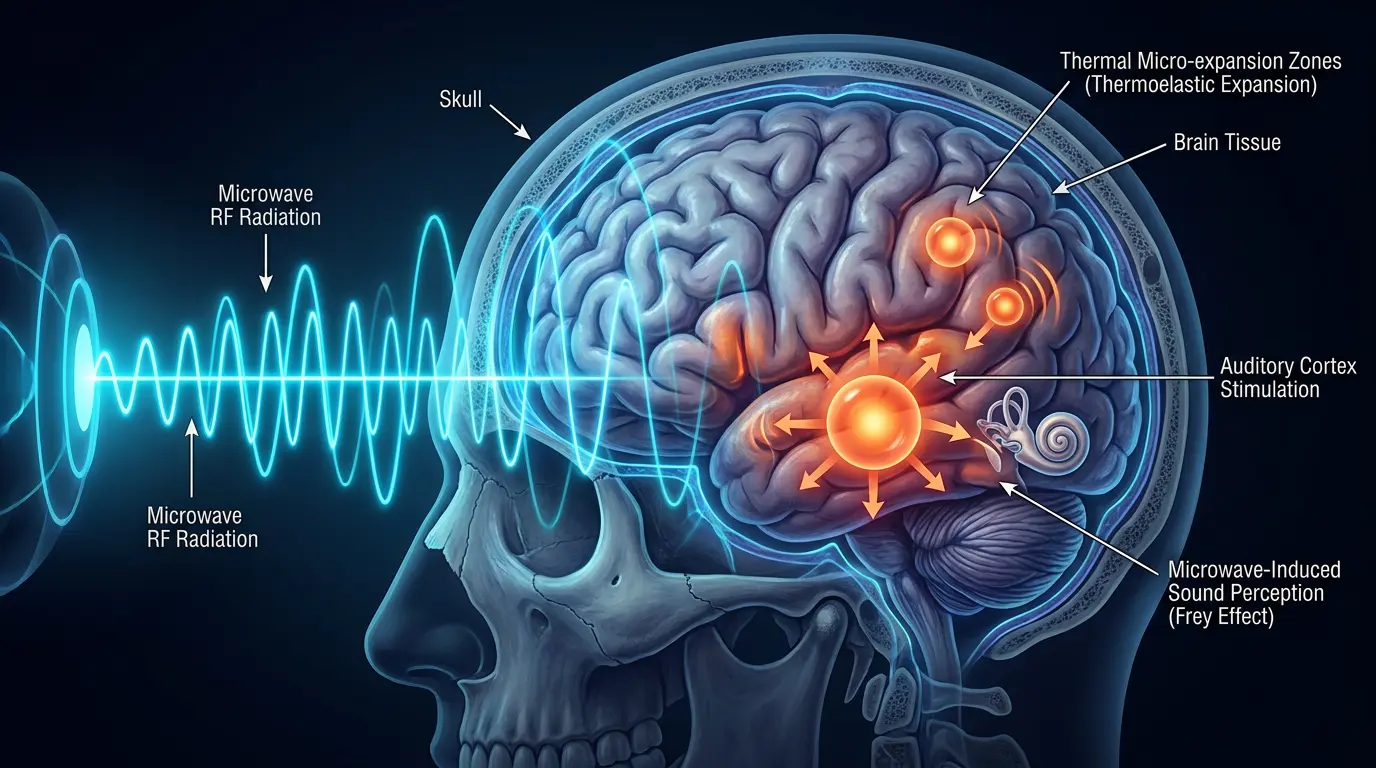
The Frey effect, first reported in 1947 by radar workers and extensively studied by neuroscientist Allan H. Frey in his landmark 1961 paper, describes the perception of clicking, buzzing, or hissing sounds when the head is exposed to pulsed microwave radiation. This phenomenon is not caused by direct neural stimulation.[10][11]
Thermoelastic Mechanism
The accepted mechanism is thermoelastic expansion: a microwave pulse causes a minuscule but rapid temperature increase (as low as 10⁻⁶ °C) in cranial tissue. This launches a pressure wave (acoustic transient) that travels through the skull to the cochlea, where it is detected by hair cells and perceived as sound. The effect is triggered when the energy flux in a single pulse (1–20 µs) exceeds approximately 40 µJ/cm².[10][11]
Experimental Parameters
'Havana Syndrome' Connection
The Frey effect gained renewed attention following reports of "anomalous health incidents" (AHI) experienced by U.S. embassy personnel in Havana, Cuba (2016–2017) and later at other diplomatic posts. Symptoms included hearing unusual sounds, headaches, and cognitive difficulties. A 2020 National Academy of Sciences report concluded that "directed, pulsed RF energy" was the most plausible explanation for the reported symptoms, though this conclusion remains contested. A 2024 ODNI assessment found no evidence of foreign adversary involvement in most cases.[11][56]
Why the Frey Effect Matters
It provides definitive proof of a non-thermal, direct interaction between EM fields and biological systems — challenging assumptions that bioeffects require significant heating. The Frey effect works through a genuine physical mechanism (thermoelastic expansion) that is well understood, but the energy per pulse is far below any thermal heating threshold. This prompted safety standards to account for peak power density in addition to average power.
Proposed Non-Thermal Biological Mechanisms
Beyond the well-established Frey effect, several other non-thermal mechanisms have been proposed to explain observed bioeffects of RF radiation at sub-heating intensities. These remain areas of active investigation and scientific debate.[9][14][55]
Calcium Ion Efflux (Adey Windows)
W. Ross Adey's research in the 1970s–80s identified "power windows" and "frequency windows" where RF-modulated fields at specific amplitudes and ELF modulation frequencies altered calcium ion efflux from brain tissue. Effects occurred only within narrow parameter ranges and disappeared at higher or lower intensities, suggesting a non-linear, resonance-like biological response. The phenomenon has been partially replicated but the underlying mechanism remains unclear.[14]
Free Radical Pair Mechanism
The radical pair mechanism, well-established in magnetoreception (bird navigation), proposes that weak magnetic fields can influence the spin dynamics of radical pairs in cryptochrome proteins. The effect could alter reactive oxygen species (ROS) production, potentially linking RF exposure to oxidative stress. This is the most physically plausible non-thermal mechanism identified to date.[55]
Dielectrophoresis & Protein Conformational Changes
Some researchers have proposed that microwave fields could exert forces on polar molecules or induce conformational changes in proteins through dielectric interactions. However, theoretical analysis shows that thermal noise at body temperature (kT ≈ 4.1 × 10⁻²¹ J at 37°C) overwhelms the energy contributed by any RF field at regulatory levels. This remains the fundamental challenge for all proposed non-thermal mechanisms.[9][55]
Membrane Effects & Ion Channel Gating
The cell membrane voltage (~70 mV across ~7 nm) creates an enormous electric field of ~10⁷ V/m. Some models suggest that RF fields could alter membrane potential or ion channel gating kinetics, even at sub-thermal levels, through stochastic resonance effects — where weak signals are amplified by biological noise. Experimental evidence is mixed and the theoretical framework is incomplete.[14]
International Safety Standards & Organizations
Multiple international bodies establish and review RF exposure limits, each using slightly different metrics and safety factors. The two dominant frameworks are ICNIRP (used by most of the world) and the FCC/IEEE standards (used in the USA).[27]
| Organization | Basis | SAR Limit (head) | Last Updated |
|---|---|---|---|
| ICNIRP | Thermal effects only | 2.0 W/kg (10g avg) | 2020 |
| FCC (USA) | ANSI/IEEE C95.1 | 1.6 W/kg (1g avg) | 1996 (reaffirmed 2020) |
| IEEE | All established mechanisms | 2.0 W/kg (10g avg) | 2019 |
| Health Canada | Safety Code 6 | 1.6 W/kg (1g avg) | 2015 |
The key difference between FCC and ICNIRP standards lies in the averaging volume: FCC uses 1 gram of tissue while ICNIRP uses 10 grams. The smaller averaging volume produces higher peak SAR values and is considered more conservative. The ICNIRP 2020 guidelines introduced absorbed power density (APD) as the primary metric for frequencies above 6 GHz, replacing SAR, to better account for the shallow penetration depth of millimeter-wave radiation.[27][55]
The Thermal vs. Non-Thermal Effects Debate
The existence and mechanisms of non-thermal biological effects at low RF field intensities remain one of the most debated questions in bioelectromagnetics. While thermal effects are well-documented and form the basis of current safety regulations, research has reported altered EEG rhythms at power densities approximately 10 dB below thermal limits, with clear dependence on modulation frequency.[9][11]
Key Controversy Points
Replication failures: Many reported non-thermal effects have proven difficult or impossible to replicate independently. The BioInitiative Report (2007, 2012) summarized thousands of studies claiming non-thermal effects, but its methodology and conclusions were criticized by WHO, ICNIRP, and multiple national health agencies.
NTP study: The U.S. National Toxicology Program's $30M 10-year study (2018) found "clear evidence" of heart tumors in male rats exposed to high-level GSM/CDMA RF radiation (2 and 6 W/kg whole-body SAR). However, the exposure levels were well above safety limits and environmental exposures, limiting direct applicability to humans.[55]
IARC classification: In 2011, IARC classified RF electromagnetic fields as "possibly carcinogenic to humans" (Group 2B), primarily based on the Interphone study's findings regarding heavy mobile phone use and glioma risk. This classification places RF in the same category as talc, pickled vegetables, and gasoline engine exhaust.[55]
The WHO established the International EMF Project in 1996 to systematically review the scientific literature and work toward international consensus. The prevailing scientific consensus: while non-thermal effects have been observed in laboratory settings, they have proven difficult to replicate consistently, and current safety standards based on thermal effects provide adequate protection for public health.[9][27]