Hypothetical Pathways to Remote Neuromodulation
Given that direct satellite-to-brain neuromodulation is physically impossible with current physics, what theoretical technologies could bridge the gap? A speculative but scientifically grounded exploration.
Speculative Content Notice
The following pathways are theoretical extrapolations based on emerging research. None of these technologies currently exist in a form capable of remote neuromodulation. This section is intended for academic and creative exploration, not as a claim of feasibility.
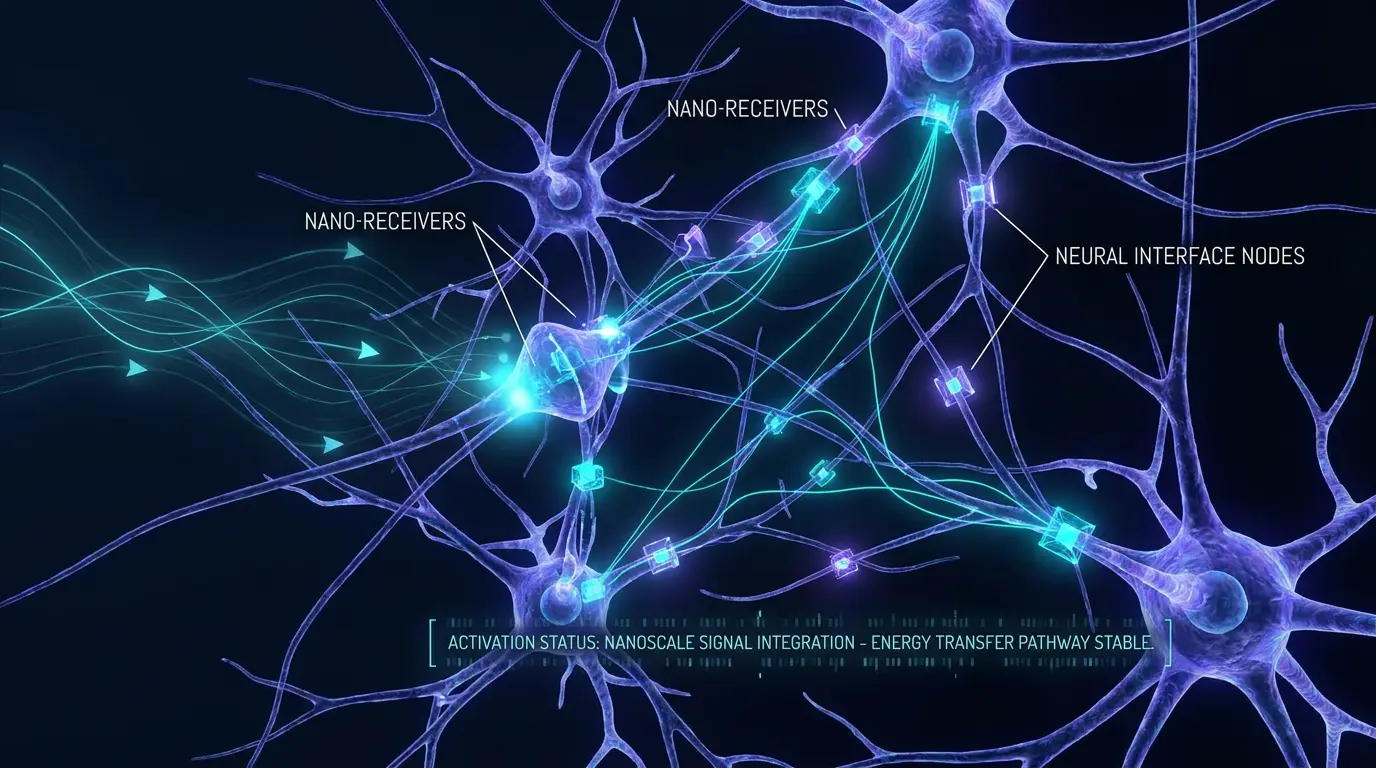
Pathway 1: Nanoscale Neural Receivers
The most scientifically plausible bridge between orbital transmission and neural modulation would involve implanted nanoscale receivers — devices small enough to reside within or near neurons, yet capable of converting weak RF signals into localized electrical or chemical stimulation.
Research in wireless neural dust (Seo et al., 2016) has demonstrated millimeter-scale devices powered by external ultrasound. Theoretical extensions to the nanoscale would require:
Energy Harvesting
Nano-antennas tuned to specific RF frequencies, converting electromagnetic energy to local current. Rectenna designs at the nanoscale remain theoretical but are an active area of metamaterials research.
Signal Amplification
Billions of nano-receivers working in concert could collectively harvest enough energy from a distributed signal. This “antenna farm” approach could theoretically bridge 10–12 orders of the 10¹⁷ gap through sheer numbers.
Feasibility Estimate: 30–50+ years. Requires breakthroughs in nanofabrication, biocompatible materials, and wireless power transfer at scales far beyond current capability.
Pathway 2: Optogenetics with Satellite-Triggered Relay
Optogenetics uses genetically engineered light-sensitive proteins (opsins) to control specific neurons with millisecond precision. Neurons expressing channelrhodopsin-2 (ChR2) can be activated by blue light (~470 nm), while halorhodopsin enables inhibition with yellow light.[20]
A hypothetical system could pair satellite-transmitted RF signals with an implanted optoelectronic relay — a subdural device that converts received RF into precisely patterned light delivered via fiber optics or micro-LEDs to targeted brain regions.
System Architecture
• Layer 1: Satellite transmits encoded command (RF signal, minimal power needed)
• Layer 2: Implanted receiver decodes signal, powered by internal battery or wireless charging
• Layer 3: Micro-LED array delivers patterned light to opsin-expressing neurons
• Layer 4: Neural response creates desired modulation effect
Feasibility Estimate: 15–30 years. Optogenetics is already proven in animal models. The main barriers are safe gene delivery in humans, miniaturized implantable optoelectronics, and regulatory approval for genetic modification.
Pathway 3: Magnetogenetics — Magnetic Field Sensitivity
Magnetogenetics aims to create neurons sensitive to magnetic fields using engineered ion channels coupled to ferritin (an iron-storage protein). The concept: neurons expressing a magneto-receptor protein would fire in response to applied magnetic fields, without requiring implanted hardware.
Early work by Wheeler et al. (2016) demonstrated remote neural activation in C. elegansand mice using engineered channels. However, the field strengths required (~50 mT) are still far beyond what any satellite could deliver at ground level.
Advantages
No implanted hardware needed — only genetic modification. Could theoretically work with external field sources if sensitivity is dramatically improved.
Challenges
Required field strengths are ~10¹ times higher than satellite fields at ground level. Reproducibility concerns: some early magnetogenetics results have proven difficult to replicate. Gene therapy delivery to specific brain regions in humans remains experimental.
Feasibility Estimate: 40–60+ years. The fundamental physics is plausible but engineering magneto-sensitive channels with the required sensitivity improvement of ~10¹ is a formidable challenge.
Pathway 4: Drone-Based Close-Proximity Platforms
Rather than attempting neuromodulation from orbit, an alternative architecture uses atmospheric drones or high-altitude platforms(HAPs) operating at 20–30 km altitude, reducing the distance by 15–20× compared to LEO satellites.
At 20 km altitude, the path loss is approximately 128 dBat Ku-band — compared to 170 dB from LEO. This 42 dB improvement represents a ~15,000× increase in power density at the target. Combined with focused beamforming and higher transmit power possible on a drone platform, this could theoretically reduce the gap to ~10¹².
Technology Stack
• Platform: Solar-powered HAPS (e.g., Airbus Zephyr-class) at 20–30 km
• Emitter: Focused microwave or millimeter-wave phased array
• Advantage: ~42 dB less path loss than LEO orbit
• Limitation: Still ~10¹² too weak for direct neuromodulation without implants
Feasibility Estimate: 10–20 years as platform. Drone platforms are already being developed for communications (Google Loon, Airbus Zephyr). However, they still cannot achieve biological-level power delivery without implanted receivers.
Pathway 5: Hybrid BCI-Satellite Uplink/Downlink
Perhaps the most realistic near-term pathway doesn’t involve satellite-based stimulation at all, but rather uses satellites as a communication backbonefor BCI systems. The architecture:
Concept
An implanted BCI (like Neuralink) communicates via a local transceiver that uplinks to satellite constellation. Remote operators or AI systems receive neural data, process it in the cloud, and send stimulation commands back via satellite downlink to the implant.[2][8]
Key Insight
This inverts the problem: the satellite provides data transmission (which it excels at), while the implant provides local stimulation (which requires proximity). This is essentially telemedicine at the neural level.
Feasibility Estimate: 5–15 years. All component technologies exist: BCIs are in clinical trials, satellite internet is global, and low-latency cloud processing is mature. Integration is an engineering challenge, not a physics barrier.
Ethical Considerations
Any technology capable of remote neural influence raises profound ethical questions that must be addressed before technical capability is achieved, not after.
Consent & Autonomy
Neural sovereignty — the right to cognitive liberty and freedom from unwanted neural intervention — must be legally enshrined.
Dual Use
Any therapeutic neuromodulation technology has inherent potential for misuse. Governance frameworks must precede deployment.
Access & Equity
Advanced neurotechnology must not create cognitive divides between those who can afford enhancement and those who cannot.
Regulation
International regulatory frameworks for neurotechnology are still nascent. The Neurorights Foundation and similar organizations are leading early efforts.